

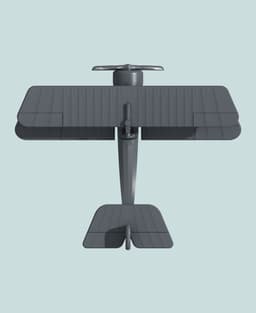

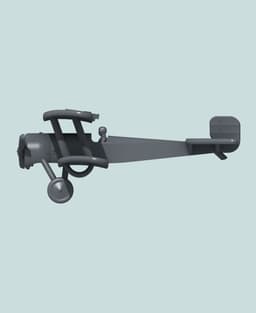


1:144 Bristol Scout C

This is a paintable 1:144 scale model of a Bristol Scout C with a top-wing Lewis gun. Also available is a Bristol Scout D with a synchronized Vickers gun. Since many painters choose their own mounting system, no peg is included on the plane. Pegs can be purchased separately in the Accessories section of this catalog.
The Bristol Scout was a pre-war racing design with simple and handsome lines. For clarity, the prototype was given the name Bristol Scout A. The first two production machines, named the Bristol Scout B, were sent to France as quickly as they cleared testing, they differed in only minor ways from the original.
The next order of twelve scouts for the RFC and twenty-four for the RNAS became the Bristol Scout C, and after the first batch was delivered in March 1915, a second order for seventy-five was placed. They differed little from the Type B -- the main visible change being the removal of stiffening ribs from the engine cowl. As was common at the time, the were scattered among many squadrons in small numbers and mixed with other scouts and two-seaters. Planes with Gnome engines were reserved for the RNAS because the engine they were more likely to be flying over water and the Gnome was thought to be more reliable than the Le Rhone. Partly through Production of the Type C a widened tail was fitted and the dihedral was increased to 3 degrees.
Eighty Bristol Scout Ds were ordered by the RFC in late 1915 for the RFC. The Type D had shorter ailerons and increased dihedral and the Le Rhone engine. Late production RNAS Type Ds used the 100hp Gnome Monosoupape engine, but vibration problems forced the final twenty RNAS Type Ds to revert to the 80hp Gnome.
While most Scouts were delivered unarmed, various jury-rigged guns were mounted, and Scouts built for the RFC in 1916 used a synchronized Vickers machine-gun with the Challenger or Scarff-Dibowski interrupter.
Eighty RFC Scouts were sent to France in total, and they served through summer 1916, after which they were repurposed as trainers. Thirty-two went to the Middle East, nine to Home Defense, and 115 went straight to flight schools. The early piecemeal distributions of Scouts can be illustrated by unit strength in September 1915 when seven Squadrons had one Scout each and No.8 had two.
For more data and gaming info on this plane, see https://linen.miraheze.org/wiki/Bristol_Scout.
1:144 Bristol Scout C

1:144 R.A.F. F.E.2d (Vee)

1:144 R.A.F. F.E.2d

1:144 Zeppelin-Staaken R.VI (R.52)

1:144 Zeppelin-Staaken R.VI (R.30)

1:144 Zeppelin-Staaken R.VI (R.25)

1:144 Siemens-Schuckert E.I

1:144 Sopwith Tabloid

1:144 Sopwith Schneider

1:144 S.I.A. 7b

1:144 Salmson 7

1:144 Sablatnig N.I

1:144 Rumpler G.III

1:144 Rumpler G.II

1:144 Rumpler G.I

1:144 Rumpler C.VII

1:144 Rumpler C.IV

1:144 Rumpler C.Ia

1:144 Rumpler C.I

1:144 Rumpler B.I
