

1:8 DeLorean Door Locks and Window Guides

** Tutorial video available on the YouTube channel**
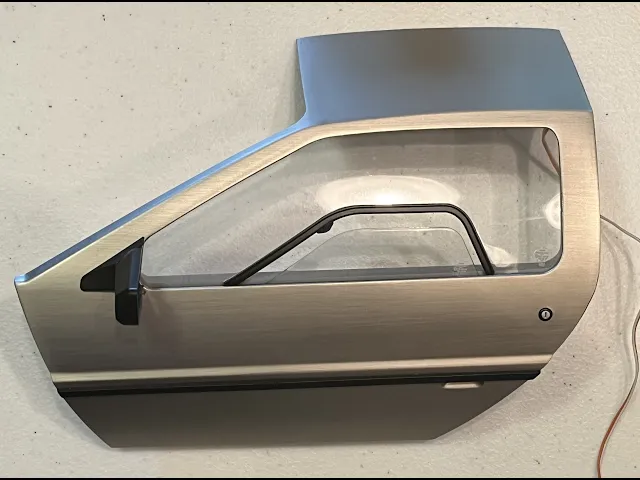
Make your door exterior look like the real car! This is a direct replacement to the Eaglemoss / Fanhome 1:8 scale Time Machine DeLorean external door locks as well as the addition of the trapezoid window guides. Dimensions were taken from real DeLorean door locks and window guides and scaled to 1:8, no other sizing modifications were required to get these to fit so they are 100% accurate to the real car. The stock door locks are too thick and the cylinder diameter is too small. And the window guides are missing entirely. This new door lock cylinder comes separate from the bezel to keep painting borders crisp. The new door locks will need to be installed using IP screws instead of the stock AP screws due to the AP screws are too long, so just a heads up on that. Due to the tiny nature, extra parts are included.
**Disclaimer: **Please consider that these parts are extremely small and let that factor into your decision to purchase. The two most challenging parts of the build will be installing the lock cylinder into the bezel and gluing the window guides into place. The door lock parts should fit together fine as I have modeled in a gap to allow for fine detail primer and 1 coat of airbrushed paint before being assembled, a chamfer is modeled to the back side of the cylinder to help guide it in, and the lock is keyed (no pun intended) to ensure it falls into the correct orientation into the bezel, however you will still need to manage handling these very tiny parts so please factor that in. The challenging part of the window guide install is getting the guide into position and managing the super glue application. Use masking tape to protect the parts or there may be damage to the finish of the trim and window guide. This model upgrade might not be for everybody. However if you do decide to go through with it, it will pay off as it's going to add the missing details to your DeLorean doors.
Items needed for this model:
- 2 IP screws (IMPORTANT: Do not use the longer stock AP screws as this will force the lock cylinder out of the bezel).
- Fine detail primer
- Flat black paint for the lock bezels and window guides.
- Satin finish for the window guides.
- Silver, aluminum, or chrome paint for the lock cylinders.
- Gloss clear coat to be applied once the lock cylinder and bezel are glued together. (IMPORTANT: Do not apply finish coat to the lock cylinder and bezel separately. The added buildup of the finishes will prevent the cylinder and bezel from fitting together. There is only enough of a gap for 2 coats of primer and paint.)
- Super glue for the window guides.
- Masking tape for the installation process of the window guides.
- Model glue or super glue with a very small applicator tip to apply glue through the hole in the back of the lock bezel for the lock cylinder bonding. If you do not have a small nozzle applicator, this can be achieved by applying the glue with a toothpick. Alternately you can apply the glue to the inside of the bezel before the lock cylinder is installed, however if you need to remove the cylinder to reposition it might be a bit messy.
- Microfiber cloth to protect the silver painted lock during fitment.
- A tiny flat head screw driver is nice to have to adjust the positioning of the window guide as the glue sets.
- Optional: Black wash to apply into the keyhole of the cylinder for added visual depth. I found that using flat black paint and something very tiny, like a shard from a toothpick to apply into the keyhole worked very well. Before the flat black paint fully cured, I took another toothpick shard and gently scraped some of the black paint off to expose some of the silver as the real car is not fully black in this area but more-so just black on the inside edges.
Painting and assembling (recommend using an airbrush to keep coats thin to preserve detail and aid in fitment):
Prep and Painting -
- Wash the parts in warm water with dish soap and a soft brush to remove the wax coating to help with paint adhesion. Gently run your fingernail over the flat surfaces of the lock cylinder and window guide to remove stuck on wax buildup. (Note that after priming will be an opportunity for you to inspect for tiny raised spots of remnant wax. If you find buildup they can be easily corrected by gently removing with your fingernail.)
- Cut threads into the back of the bezels by installing IP screws. It's good to do this step before painting, you don't want to force handle these parts more than you have to once paint and finish is applied.
- Prime 2 coats of Tamiya Fine Surface Primer (allow at least 8 hours between coats or you may get a rough finish, dry times vary).
- Paint the bezels and window guides flat black. (Recommend Tamiya XF-1 Flat black.)
- Paint the cylinders silver (I used AK Extreme Aluminum).
- Apply a satin finish to the window guides. (I used Vallejo satin varnish.)
Assembling and installing the lock -
- Install the lock bezel into the door using an IP screw. This is to align the cylinder.
- Install the cylinder with the keyed nub at 12:00 and gently push into place using a microfiber cloth to not get fingerprints on the newly painted silver.
- Check to see if the cylinder is seated flush with the bezel. If not, apply some pressure using the microfiber cloth. If more pressure is needed, remove the lock from the door and press face down into a microfiber cloth on a solid flat surface. IF it is not fitting, remove the cylinder by sticking something through the hole in the back of the bezel to pop it out, and consider removing some of the paint buildup on the sides of the cylinder and try again. It should not have to be forced into place with much pressure.
- Once positioned at 12:00 and flush, apply glue to the back side of the cylinder by access through the hole in the bezel. Extra glue can be removed by using a toothpick to fish the extra glue out.
- Once the lock cylinder and bezel are together, apply a gloss coat to the assembly.
- Optional: Using a black wash or black paint, apply a very small amount to the keyhole for added depth. The tiny shard of a toothpick works well for this.
- Install the door lock assembly into the door using the IP screw. Only engage the screw until snug to not strip the threads. This is approximately 1 and a quarter turn of the screw.
Installing the window guide -
- The door windows should already be installed into the door. Install the window guide by attaching the outer face of the window guide to a piece of scotch tape.
- Apply a small piece of masking tape to the area of the small window where the window guide will be installed, apply a tiny piece to the flat visible surface of the window guide, and apply a longer piece to the black trim of the large window. This is all to protect the finish of these areas during gluing and positioning.
- Roll the small window all the way up.
- Place a mark on the tape on the large window trim at 29.5mm (1.16 inches) up along the length of the trim and this will be where the bottom edge of the window guide should be installed.
- Position the door so the window is about horizontal to do the work. If the door is off of the car, this is just the natural way the door sits, but if it is already installed onto the car, just make sure the doors are in the open position. This is important as you will want to take one of the extra door guides and lay it onto the small window, pointed side facing where you are installing the other door guide in such a way that your new door guide short edge can rest on the short edge of the other door guide edge. This is to angle it off of the small window as it is true to the real car and will also aid in making sure the bonded edge of the door guide has contact with the large window trim as the bonded edge has an angled surface built into the part to give it the correct outward installation angle.
- Pick up the window guide in your dominate hand using the small piece of masking tape as a way to hold onto the part. Apply a thin layer of super glue to the bonded edge with other hand and then position the part into place. Allowing the short edge to rest on top of the short edge of your second window guide. You can use a tiny flat head screw driver to push and tap the window guide into position.
- After about 15-30 seconds, roll the window down and apply a bit more super glue to the inside edge. This is also a good time to adjust the angle of the guide if needed before full cure of the glue. Also a good time to remove the longer piece of masking tape from the trim. Leave the tiny piece on the window guide until glue is fully cured.
- After fully cured and all tape removed, inspect area and apply satin black touch up as needed to the area, however the tape should be enough protection.
1:8 DeLorean Door Locks and Window Guides
.png&w=3840&q=75)
COMBO PACK 1:8 Scale DeLorean Side Grills with Door Locks and Window Guides
Window roller blinds guiding line for tilt and turn windows

Smaller Window and Door for 1:24 Scale Roombox
Enchanted Fairy Door & Window

1:8 BTTF DeLorean Door Sills

Eufy Contact Door Window Sensor - Outdoor Case
Pi Zero door & window cam
Glass shower door guide

Melting Paint Wall Decoration – Dripping Wall Accent for Doors, Windows & Corners

Powered Shade Window Lip Guides
Doors and Windows - Building Decorations
1:8 BTTF DeLorean door lamp lens set of 6

Philips Hue Contact Door Window Sensor - Outdoor Case

Closet Door Guide

Hive Contact Door Window Sensor - Outdoor Case

IKEA Parasoll/Myggbett Contact Door Window Sensor - Outdoor Case
.jpg&w=3840&q=75)
Aqara Contact Door Window Sensor - Outdoor Case

Tapo T110 Contact Door Window Sensor - Outdoor Case
Sliding Closet Door Floor Guide