


Taasen Pieces

Taasen is an abstract strategy game from another universe.
Jennifer Diane Reitz invented Taasen as part of the cultural fabric of Tryslmaistan, the alien cosmos where her webcomic Unicorn Jelly takes place. Tryslmaistan has different physics than our universe, different societies, different traditions. Taasen is what the people there play.
The game works like chess or Go—pure strategy, no luck, everything visible. You can learn it in twenty minutes and spend years getting good at it. Three factions fight for control of a triangular worldplate, but only two players move the pieces. The rock-paper-scissors combat system creates weird tactical situations you won't find in other games.
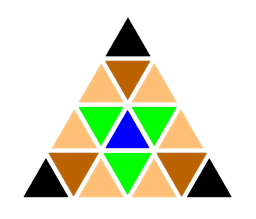
Taasen means "To Conquer" or "To Colonize" in the ancient talcryl language. The board is shaped like a Tryslmaistan worldplate: dark corners for the unknown, a blue sea in the center, green forests around it, tan crystal deserts at the edges. Every design choice connects to the mythology Jennifer built.
PRINTING
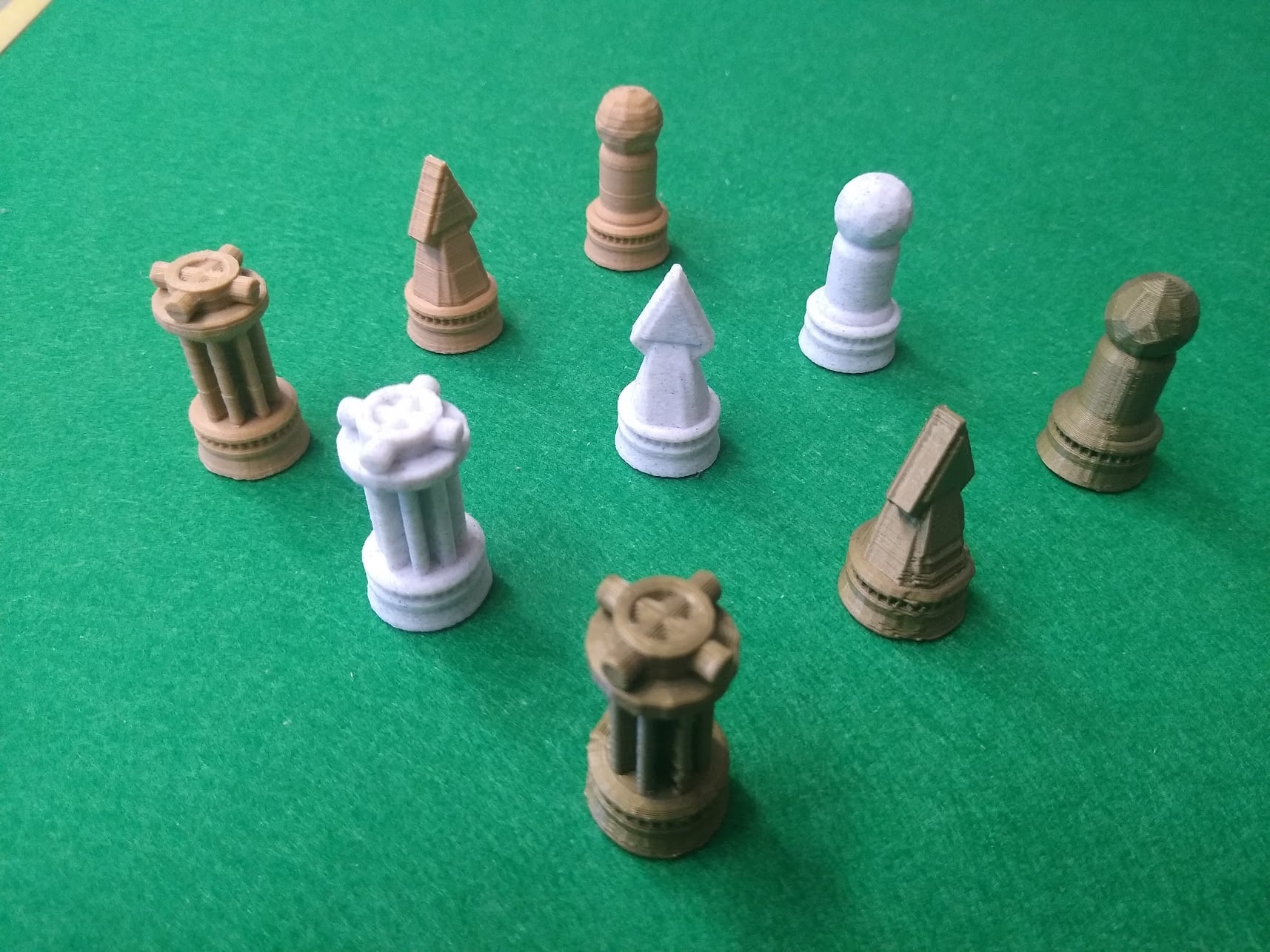
For one full Taasen set, print three groups.
Each group should have one each of each shape: Thaum, Sciane, and Paupil; for nine total pieces.
Each group should be a different color. Traditionally the colors are red, green, and white.
You will also need a board to play on, which is an equilateral triangle divided evenly into 16 smaller triangles.
ABOUT THE GAME'S ORIGINS
In the world of Tryslmaistan, nobody agrees on where Taasen came from.
Some say it was invented by the third generation of the First People—mythical ancestors who came from the Dark Realm hundreds of thousands of years ago. More practical types claim it was an Alchemist's invention on the worldplate of Myrmil, maybe 400 or 500 years back. The Witches insist the Goddess gave it to the 13 Progenitors exactly 1,313 years ago when she created the universe.
Whatever the fictional history, Jennifer Diane Reitz invented Taasen in 2001 for Unicorn Jelly. She didn't just mention that the characters played a game—she designed the whole thing so readers could actually play it.
The triangular board mirrors Tryslmaistan cosmology. Each worldplate is a flat triangle floating in infinite void, with a central sea, forests, and crystal deserts at the borders. The three dark corners represent either the Dark Realm where the First People supposedly originated, or the ignorance of new colonists arriving on an unexplored plate.
The three factions—Thaum (Wiccans), Sciane (Alchemists), and Paupil (common people)—are the major power groups in Tryslmaistan society. The game lets two players fight for control while the third faction remains neutral, manipulated by both sides.
COMPONENTS
The Board
One triangular playing surface divided into 16 smaller triangles:
- Three dark corners (the Dark Realm or initial ignorance)
- One blue central triangle (the Central Sea)
- Three green triangles around the sea (forests)
- Tan border spaces (crystal deserts)
The Pieces
Nine pieces total, three complete sets of three:
- 3 Red pieces: 1 Thaum, 1 Sciane, 1 Paupil
- 3 White pieces: 1 Thaum, 1 Sciane, 1 Paupil
- 3 Green pieces: 1 Thaum, 1 Sciane, 1 Paupil
What the Pieces Represent
- Thaum: The Wiccans—magic users who work with mystical forces
- Sciane: The Alchemists—proto-scientists, rational experimenters
- Paupil: The common people—unaligned workers, the masses
SETUP
Group the pieces by color and put each complete set on one dark corner.
One player controls Red. The other controls Green. White is neutral—both players can move White pieces.
This is the only time multiple pieces can occupy the same space. Once pieces leave the corners, only one piece per space, ever.
Red moves first. In Tryslmaistan mythology, this represents the mobility of Red (Meat) Life.
HOW TO PLAY
On your turn, move exactly one piece exactly one space.
You can move one of your colored pieces, or you can move a White piece. You cannot move your opponent's colored pieces.
That's it. Players alternate until someone wins.
MOVEMENT RULES
A piece moves one space in any legal direction.
A legal move crosses the straight border between two adjacent triangles.
Moving across triangle points (where triangles only touch at a corner) is illegal.
You cannot move into an occupied space.
The triangular board creates interesting geometry. Most spaces have three neighbors, but corners and edges have fewer. Study the board to understand what connects to what.
THE CENTRAL SEA
The blue triangle is the sea. It works differently.
Any piece moving into the sea cannot stay there. It must immediately move to another empty space bordering the sea. If no empty space is available, you cannot cross.
This is the only exception to the one-move rule—crossing the sea is a double move.
The sea provides rapid transit but requires timing. You cannot use it if all exits are blocked, and crossing might expose you to attacks from multiple directions.
PUSHING AND CRUSHING
Pieces do not capture by moving into occupied spaces. They Push.
When you move adjacent to an opposing piece (or a White piece), and your piece has power over that type, the defending piece is Pressed and must immediately move.
The defending player chooses where the Pressed piece goes—but they must move it to any legal empty space.
If no legal empty space exists, the piece is Crushed (captured) and removed from the game.
You cannot Push your own faction's pieces. Only one piece can be Pushed per turn—no chain reactions. A Pushed piece does not become active when it moves—it cannot Push other pieces just because it was forced to relocate.
PIECE INTERACTIONS
Not every piece can Push every other piece. Taasen uses rock-paper-scissors:
Thaum Pushes Sciane
Sciane Pushes Paupil
Paupil Pushes Thaum
A Thaum cannot Push another Thaum or a Paupil—only Sciane.
A Sciane cannot Push another Sciane or a Thaum—only Paupil.
A Paupil cannot Push another Paupil or a Sciane—only Thaum.
Two pieces of the same type can sit next to each other safely. Neither threatens the other. You can "snuggle up" to certain opponents to block them, and they cannot Push you away.
VICTORY CONDITIONS
You win immediately if either condition is met:
Elimination: Your opponent has no pieces of their own color left. (White pieces do not count.)
Immobilization: Your opponent cannot make any legal move with any piece they control.
Draw: The game is a draw if no attack by any faction is possible, both players have equal types and numbers of pieces, and neither player can move.
White can never win—it is neutral, controlled by both players. If you have no pieces of your own color left, you lose even if White pieces remain.
SPECIAL RULES
To prevent infinite loops, recursion is forbidden:
White Piece Recursion
You cannot move a White piece your opponent just moved on their last turn.
Pushed Piece Recursion
If your opponent Pushed one of your pieces, you can move that piece on your turn—but not back to where it was Pushed from. Move it anywhere else legal.
Without these rules, players could undo each other's moves forever.
STRATEGY TIPS
Get your pieces out of the corners fast. Corners are traps—stay out once you escape.
Before leaving a corner, look at nearby pieces and choose which of your three pieces will be most useful.
Position your pieces where they threaten enemies while avoiding pieces that threaten them back.
Remember: three factions, two players. White is both opportunity and threat.
Set up positions where Pushing your piece would force it into a threatening location.
Push enemy pieces toward board edges where they have fewer escape routes.
Use the sea for surprise attacks, but watch out—you cannot Push through the sea (it is still a space), but you can Push a piece across it.
Create traps with seemingly pointless moves that set up forcing sequences later.
Block yourself intentionally only when you have a plan—trapped pieces are useless.
Think about what your opponent will do with White pieces, not just their own.
Sometimes sacrificing a piece for better positioning is correct.
Traditional Wisdom: "When playing at Taasen, Push the Pauple until it perishes." The Paupil gets underestimated but can topple the mighty Thaum. Do not ignore any piece type.
ABOUT UNICORN JELLY
Taasen comes from Unicorn Jelly, Jennifer Diane Reitz's webcomic that ran from 2001 to 2003.
The story follows Uni, a slime monster who wants to become a unicorn—a Holy Creature representing an ideal. The comic explores transformation, identity, friendship, and the tension between rationalism and mysticism.
The main characters are Uni (the slime), Lupiko (a young witch representing humanity and compassion), and Chou (a scholar embodying intellect and reason).
Despite the fantasy aesthetic, Unicorn Jelly is hardcore science fiction. Tryslmaistan has completely different physics from our universe:
Reality consists of triangular worldplates floating in infinite void. Each plate has unique properties. Light, gravity, matter—everything works differently. "Magic" exists but operates on consistent physical principles.
Jennifer built an entire alien culture: mythology, social factions, games, art, music, traditions. Taasen is not just set dressing—it is a fully playable artifact from that culture.
Unicorn Jelly pioneered the "mangastrip"—Jennifer's term for synthesizing Japanese manga storytelling with American comic strip format for web publication. The story has a definite beginning and end. Every event matters.
You can read Unicorn Jelly at unicornjelly.com.
ABOUT THE CREATOR
Jennifer Diane Reitz is a game designer, artist, and storyteller who has been making games since 1981.
She started with tabletop role-playing, then moved to computer games in 1985 with a sale to Activision. She created tile sets for the original Shanghai and worked on projects like Aliens, Transformers, and the Gamemaker Science Fiction Library. She was design consultant for Electronic Arts' Legacy of the Ancients and worked with Epyx, Sculptured Software, Interplay, and others.
With Stephen Lepisto, she founded Accursed Toys and created Boppin' for Amiga and PC, Laboratory of Life (a playable artificial life simulation), and various other projects.
Jennifer's game collection includes over 3,700 titles across every successful platform released in North America—essentially a software museum. She believes you have to play all games to make great games.
Her work spans multiple media: traditional cartooning, digital art, game design, interactive fiction. She draws directly on computer using a mouse, matching the style of Japanese brush pens from her sketches.
She describes herself as an "Eternal Child" who believes real maturity comes from being childlike rather than childish. She lives in a polyamorous family with her three spouses and considers friendship, loyalty, honor, commitment, and compassion her guiding principles.
Jennifer is a transgender woman who transitioned in the early 1980s, facing tremendous adversity but ultimately finding herself and building a life of creativity and love. Her experiences inform her work's themes of transformation, identity, and becoming your true self.
For more: jenniverse.com hosts Jennifer's complete body of work..
CREDITS
Game Design: Jennifer Diane Reitz (2001)
Original Context: Unicorn Jelly webcomic (unicornjelly.com)
Thanks to Jennifer for creating not just a game, but an entire universe, and for letting Taasen exist as a physical object in our world.
About
I discovered Taasen through Project Rho's Atomic Rockets website, where it appeared as an example of fictional game design. The game stood out immediately—it's a genuinely excellent abstract strategy game on its own merits, regardless of its fictional origins. Only after playing it did I discover Unicorn Jelly and Jennifer's larger body of work, which turned out to be a pleasant surprise. I'd encountered some of her work before without even realizing it was hers.
For more information about Jennifer's work:
- jenniverse.com for her complete body of work
- unicornjelly.com to read the comic
- Explore Tryslmaistan and its stories
"When playing at Taasen, Push the Pauple until it perishes."
—Traditional Tryslmaistan saying

Drainer – Pop-Open Drain Strainer Version 2.0
Articulated Airless Snake

KROMATIK Vase 001
Articulated Dragon

Ice Cream Pint Holder - Insulated, Mix & Match, Multicolor

Monkey D. Luffy Premium Figure – One Piece
.jpg&w=3840&q=75)
Seashell Shaped Box (Snap)
Christmas Tree (LED Lamp or Decoration)

Christmas Tree (LED Lamp or Decoration)
Print in Place Snap Hook

ModPress V3 — 3-Piece Fully Printable Arbor Press
VinoGrace Elegance Wine Holder Cracked version

Christmas Tree (LED Lamp or Decoration)

Christmas Tree (LED Lamp or Decoration)
Celestial Resonance Planter grateful

Berserk Guts Sword Keychain

Mushroom Vase & Table: Standard Edition
NObody - Medito
.png&w=3840&q=75)
FREE - Australian Shepherd Dog Bust with Nameplate- Dog Statue - STL 3MF - 3D Printable Dog Model